Klinenberg, E. (2018). Palaces for the
People: How Social Infrastructure Can Help Fight Inequality, Polarization, and
the Decline of Civic Life. New York: Penguin Random House.
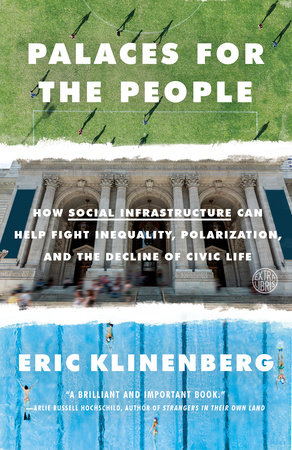 |
Image Source: https://www.penguinrandomhouse.com/books/
557044/palaces-for-the-people-by-eric-klinenberg/
|
Book Overview:
The book Palaces
for the People: How to Build a More Equal and United Society created by Eric
Klinenberg is aimed to research the influence of social infrastructure (SI) on
people’s well-being. The author defined the notion of SI as organizations
and physical places that shape the ways people interact with each other. While
being a complex phenomenon, SI includes public parks, libraries, shops,
playgrounds, schools, churches, charity funds, sports clubs, and other similar
places (Klinenberg, 2018). In the process of his research, Klinenberg came to
the conclusion that neighborhoods with a robust social infrastructure have a
greater degree of sustainability and resilience. People living in such
districts do not feel isolated since they have mutual support, collaboration,
and contacts with each other. Furthermore, strong SI protects democracy and
contributes to economic growth. In contrast, people living in the areas with degraded
social infrastructure are left to themselves and, rather often, they feel
isolated. Their loneliness results in lower life expectancy, deteriorated health
conditions, psychological problems, and lower chances to survive during such natural
disasters as heatwaves, floods, or hurricanes.
The main argument voiced by Klinenberg (2018) is
that building new social infrastructure is not less urgent than the renovation
of conventional hardline systems such as bridges, airports, and levees. The
author expressed his apprehensions associated with the growing investments in hardline
infrastructure at the expense of various social projects and pubic areas. According
to Klinenberg (2018), it is a dangerous tendency that makes the United States
more vulnerable to new challenges. This point of view is reflected in six
chapters, in which the author analyzes such aspects of the problem as the lack
of places to gather and the shortage of safe spaces as well as covers the
advantages of learning together, the importance of healthy bonds, the
significance of common ground, and the prospects for the future.
The book ends
with the conclusion in which the author researches the initiative of Mark Zuckerberg
to turn Facebook in the platform substituting SI, and Donald Trump’s promise to
build a wall separating countries and people. In Klinenberg’s opinion, these
are useless projects that will bring no improvement. The scholar offers a
different option, the one realized by Andrew Carnegie, who sponsored the construction
of public libraries built in the major cities of the USA. Even in the 21st
century, these places remain available to everyone and provide people with an
opportunity to create their robust social infrastructure.
About the Author:
 |
| Image Source: https://ipk.nyu.edu/people/eric-klinenberg/ |
Eric Klinenberg
is an outstanding sociologist and the researcher of urban studies, culture, and
media. He is also the director of the Institute for Public Knowledge at New
York University and the professor of sociology. Klinenberg is also a research
director for Rebuild by Design, a federal competition aimed to produce innovative
infrastructure. Klinenberg is the coauthor of the New York Times bestseller Modern Romance: An Investigation (2015).
He is the author of such books as Going
Solo: The Extraordinary Rise and Surprising Appeal of Living Alone (2012), Heat Wave: A Social Autopsy of Disaster in
Chicago (2003), Cultural Production
in a Digital Age (2005), and Fighting
for Air: The Battle to Control America’s Media (2008). Eric Klinenberg has
contributed to such journals and newspapers as The New Yorker, Rolling Stone, The
New York Times Magazine, and This American Life. Being an outstanding American
scholar, Klinenberg regularly participates in radio and television programs. The
author of the book is married and has two children. He was born in Chicago but
lived in many cities in the United States. He is passionate about his work and
has an excellent sense of humor.
Reading Guide Questions:
1. What places can be identified as
the ones belonging to social infrastructure?
In
his book, Klinenberg (2018) stated that public libraries belong to the most
important objects of social infrastructure. Their significance is not only in
the opportunity to exchange books and to gain knowledge. The majority of
libraries have community rooms that serve a variety of purposes since they can
be used as a theater, art studio, classroom, and civic hall. In the urban
areas, people attend these places because they give them the feeling of safety and involvement in the functioning of a
certain cultural community. It is especially important for people who live
alone and who have limited possibilities for communication with others. Despite
the fact that the author paid so much attention to public libraries, it is
possible to argue that these are not the only places that constitute social
infrastructure and enable people to communicate with each other. People can
gather in the parks, gardens, and other green zones specially created for rest
and entertainment.
2.
What is the relation between maintaining
so-called safe spaces and the level of crime?
The
experiments conducted by scholars proved that houses and neighborhoods that are
well-maintained by their residents have a lower degree of crime. Furthermore,
the results of the research cited in the book prove that vegetation has an
extraordinary power to reduce crime in high-poverty residential development.
Such surprising results are explained by the fact that well-maintained green
spaces give the feelings of ownership and control that lead to the increase of
passive surveillance. It was also proved that people living amid vegetation
feel less mental fatigue and aggression compared to those who live surrounded
by concrete buildings. The mentioned findings are rather important for city
planners who can improve the existing infrastructure without spending millions
of dollars.
3.
Are educational institutions the
objects of social infrastructure?
All
educational institutions, together with playgrounds, gyms, research centers, teaching
halls, dormitories, and other buildings, are elements of social infrastructure.
This claim is based on the fact that young people not only learn there, but
also acquire and develop skills for community building and civic engagement.
Still, the author of the book indicated that the effectiveness of such skills
depends on the level of openness of educational institutions. A big number of
schools introduced security guards on their perimeters and in this way, they
limited access to their territories. According to Klinenberg (2018), it is a negative
tendency because such limitations do not allow students to interact with the
people who do not belong to their social group. To cope with this problem,
schools should have open and accessible grounds with amenities.
4.
What is the influence of opioid
addiction on social infrastructure?
In
the 1990s, the United States experienced one of the most devastating health
crises caused by the dramatic increase in the sale and use of pain relievers
and street drugs. This addiction brought tragic consequences to the country.
Thousands of people died because of overdose, and a big number of communities
were ravaged. Besides, the opioid epidemic brought huge financial losses that
approached the figure of $80 billion. Klinenberg (2018) explains a fast spread
of this problem by the loss of social support and cohesion. Traditional social
institutions and rituals which served as sources of support were ruined, and in
the conditions of increased unemployment, people tried to cope with their
loneliness by using drugs. In the process of his research, Klinenberg (2018)
identified that strong community ties prevented people from becoming heroin addicts
and decreased the chances of death as the result of an overdose. This fact
enabled the scholar to argue that robust social infrastructure has a positive
influence on the health of separate individuals and the country as a whole.
5.
How does Eric Klinenberg
interpret the idea of “wall” and why is he so critical about it?
In
the book, Klinenberg (2018) stated that after hurricane Sandy, the idea of
building a huge wall protecting New York from the ocean water became widely
supported by scholars and politicians. There were offered various designs of
this construction, and it seemed to be the easiest solution. With the beginning
of Donald Trump’s presidential campaign, the idea of constructing the barrier
on the border reentered the political agenda. This wall was supposed to protect
the United States from migrants and in this way solve the problems of the
country. In the process of his research, Klinenberg (2018) determined that the
construction of a barrier would bring more harm than benefit. He argued that it
would ruin the ecosystem of the Hudson River and threaten to flood New Jersey.
The idea of the wall on the border is also dangerous because it supports and
legitimizes the segregation of American society. Instead of fostering
cooperation between different social groups, it contributes to their isolation.
6.
What is the potential of
developing social infrastructure?
The
main idea of Palaces for the People is
that developing social infrastructure is as important as the renovation of conventional
hardline systems. The examples included in the book prove that without social
cohesion between people and their support of each other, the country would
hardly be able to cope with the challenges and threats brought by the 21st
century. Unfortunately, little attention
is paid to the problem of social infrastructure, and it is possible to predict
that the epidemic of coronavirus will deteriorate the situation because it
motivates people to live in isolation. It will become one more challenge since
it will be necessary to make public spaces not only useful but also safe for
people’s health.
Palaces for the People Page Written By Tianshuang Wang, Yutong Hou, and Renjie Ma

No comments:
Post a Comment